
Access the full report in English and Français

Is the European Parliament Failing to Enforce Its Own Red Lines?

More than 50 Members of the European Parliament alerted the President of the European Parliament as early as 2024.
That request received no response.

At the same time, a request for an internal inquiry was submitted within the European Parliament.
Once again, no identifiable institutional follow-up was provided.

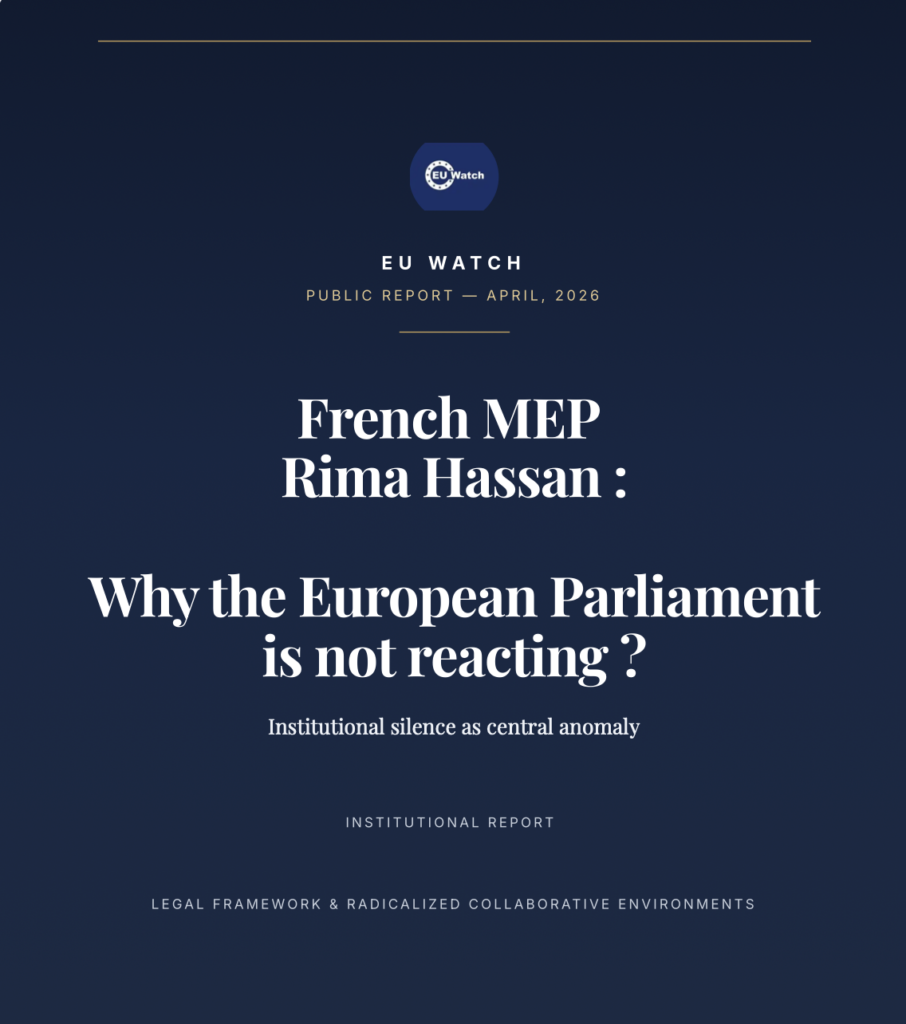
It is in this context that EU WATCH publishes a report devoted to the case of French MEP Rima Hassan.

A Report Based on Public Facts

This report is based on several months of analysis of public facts between 2024 and 2026.

It relies exclusively on open, verifiable and cross-checked sources.
It does not aim to establish liability, nor to substitute itself for judicial authorities.

Its purpose is to examine, in a rigorous manner, public facts, their sequencing over time, and the response (or absence of response) of an institution faced with these elements.

An Accumulation of Facts and Signals

The report documents:

21 material public facts

several formal institutional alerts

7 active criminal proceedings in France

a digital sequence reaching more than 15 million views

It also identifies several significant contextual elements:

⚫ three judicial summons in France in 2026

⚫ entry bans imposed by Canada and Israel

⚫ publicly available elements relating to the immediate professional environment of the MEP, including one of her parliamentary assistants

These elements are not of the same nature, but contribute to contextualizing the sequence under analysis.

Taken individually, they belong to different registers.
Taken together, they form a coherent pattern.

And yet, the institutional response remains limited.

An identified Turning Point

The report highlights a specific sequence:
the large-scale dissemination of content exposing identifiable third parties.

Within a context marked, over the same period, by acts of violence.

Without establishing any causal link, this sequence reveals a level of risk that has become visible.

A Question Beyond an Individual Case

Beyond the specific situation examined, the report raises a broader question:

  • at what threshold does an institution decide to act?
  • how does it distinguish between conduct linked to the exercise of a mandate and conduct that is not?
  • on what criteria does it activate its own disciplinary mechanisms?

Recent precedents show that such tools do exist.

An Institutional Grey Area

The report brings to light a reality that is rarely made explicit:

The European Parliament has the means to act.But the conditions under which those means are activated are not always clearly defined.

An Open Question

In this type of configuration, one question remains:

At what point does the absence of reaction cease to be institutional caution… and become a matter of doctrine?

Become an EU Watch supporter!

Would you like to support the work of EU Watch and make the EU better?

Our newsletter

Do you want to subscribe to the EU Watch newsletter?

We will keep you informed about our latest publications and events. EU Watch will store your email address in our database. It will not be shared with third parties. You can unsubscribe at any time by clicking on the link at the bottom of the newsletter. Find out more in our privacy policy.

Become an EU Watch supporter!

Would you like to support the work of EU Watch and make the EU better?
index
Who are we

EU Watch is a non-governmental organisation registered in Belgium that seeks to promote transparency, accountability and understanding of the European Union.

Read more about our mission and what we focus on.
The EU Matters Podcast COVER square (1400 × 1400 px)
Podcast

EU Watch has launched the “EU Matters” podcast. With this new format, we want to shed some light on subjects that are of importance to citizens and Brussels decision-makers alike.


Listen and subscribe to it.